
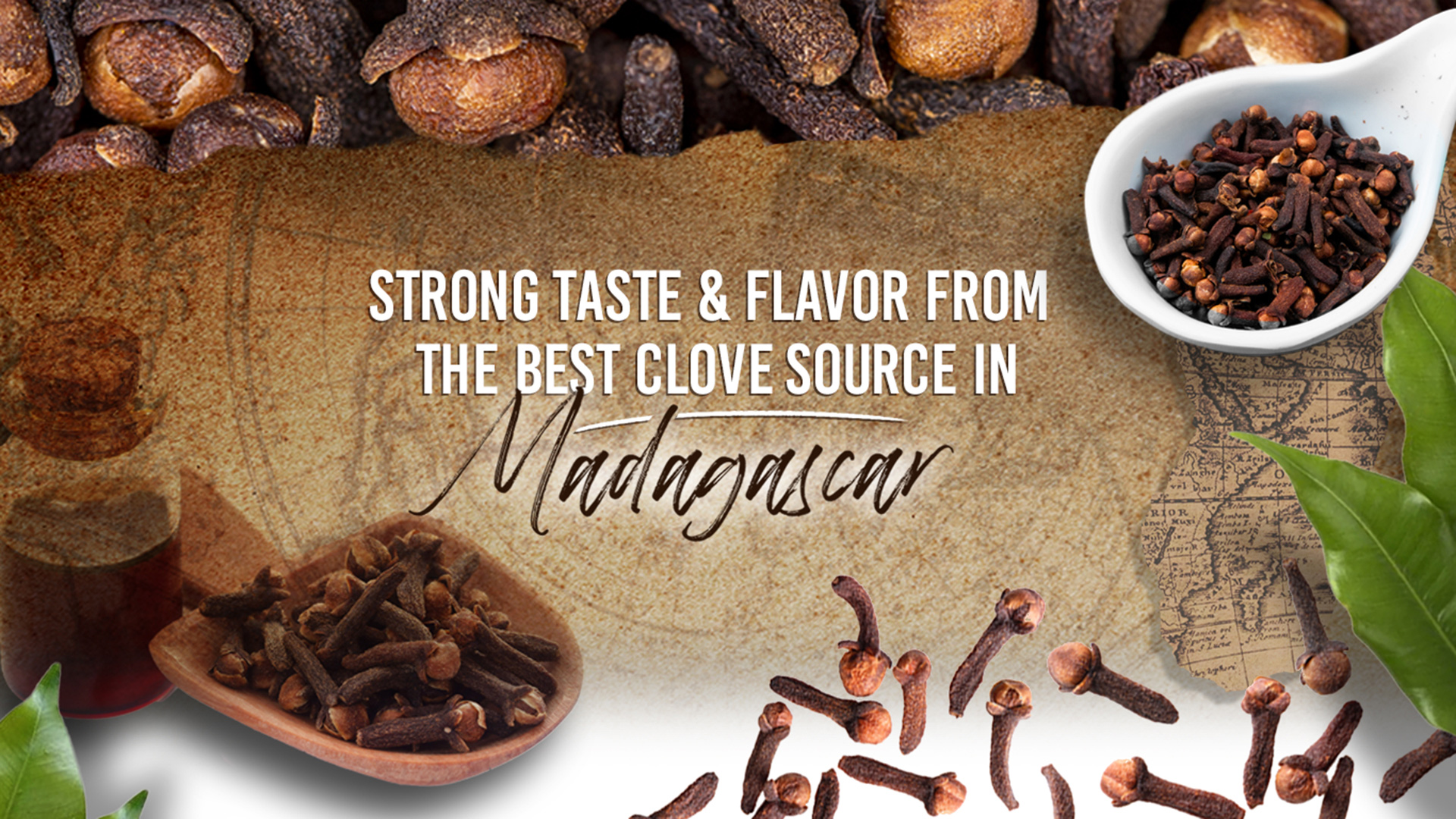
Originating directly from eastern Madagascar, cloves are one of the island’s main products. Hand-picked and hand-selected by our farmer collaborators, the harvest is done before the buds bloom and dried directly in the sun. Its quality is due to this natural-only process reflected by its dark brown colour, as well as its unique and very perfumed smell. The clove size ranges from 12mm to 17mm, with a moisture content of approximately 12%. The processing and quality of our cloves complies with the international standard required by the customers.
Madagascar is counted among the first exporters of cloves in the world, as an island with a tropical season which is perfect climate for our plantation, all along its eastern coast, where we can find this magnificent tree whose fruit is used everywhere in our daily life whether in the culinary art or in the pharmaceutical side, or even in traditional medicine.
The question arises, is the clove tree originally from Madagacar? Or if not how did it end up on the island? Following its history, back in the day the clove tree was native to the Moluccas, in the south of Asia. By smuggling it was introduced into several places including Madagascar by the Frenchman called Pierre Poivre. He introduced this plant at the latitudes and slopes of the island of Sainte Marie located off the coast of the greater Madagascar island. It is only years after this that the population began to expand the cultivation of this plant into the great island itself towards the east side that owes its name Analanjirofo, and in other regions such as Toamasina, vatovavy-fitovianany, vatomandry, Mahanoro, SAVA, DIANA. Around all regions the total production is estimated to be around 19 000 tonnes per year.
In describing it, the clove tree is a tree characterized by its conical or pyramidal shape with its evergreen leaves of an oval and very tough shape. This tree is on average 10 to 12 meters high , but occasionally can go up to 20 meters. In fact the clove we use is the clove flower itself, yet gathered before it blooms.
The clove tree can flourish under only certain conditions: a low altitude, a temperature that varies between 26 and 30 degrees, and an annual rainfall of more than 3000mm. For its cultivation, the clove tree requires a fertile soil of medium compactness. The plant cannot support the prolonged contact with water and fears the too light grounds, the more or less salted sands.
The region of the Malagasy East coast satisfies these requirements so that the clove tree is found there in abundance offering the majority of the national production. This plant starts to bloom up 5 to 7 years after its plantation.
About the production, a tree is estimated to produce 5 to 16 kg of fresh cloves, which makes around 900kg to 2 tons per hectare. The harvest of cloves is a very laborious operation, with the harvest done by hand by the farmers, taking the stalk that carries the clove. Then, is the égriffage which consists in separating the nail from the pedicel, followed by the sorting by removing the leaves and the rest of the pedicel. After we dry all the cloves in the sun for a few days.
Once in the warehouse, the cloves are analyzed to determine their moisture content, sorted (triaged) and packaged again in order to classify them into different qualities requested by the customer. The different qualities are summarized by the CG1 composed with more or less 2% of headless cloves, 0.5% fermented cloves, 1% foreign body not coming from the cloves, 1% baby cloves , and 11% of moisture rate. Next we triage the CG2 composed by more or less 5% of headless cloves, 3% fermented cloves ,0.5% foreign body, 3% foreign body not coming from the cloves, 2% baby cloves , et 12% of moisture rate. The last one is the CG3 composed by more or less 12% of headless cloves, 5% fermented cloves, 5% foreign body ,5 % foreign body not coming from the cloves, 5% baby cloves , et 13% of moisture rate.
The cloves are sold as spices for cooking or for pharmaceutical composition. The antiseptic and anaesthetic properties of the flower buds have been recognized for a long time and proposed in cases of dental pain, and the essential oil of cloves is widely used in aromatherapy. From the clove tree, we can distill the cloves, the claws, and the leaves, which also contain a high proportion of eugenol. The essences of leaves from Madagascar are known to contain a high concentration of eugenol, in a proportion of 75% to 88% in the essence.